RCAABC Winter Social 2023
Hurry up and call to reserve your tickets!
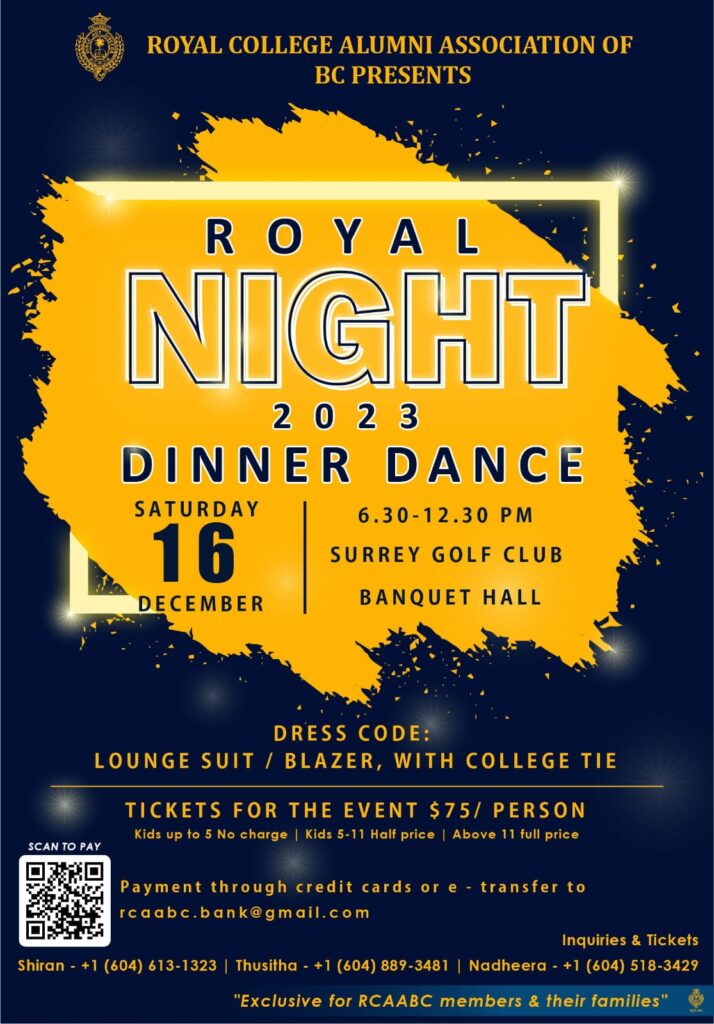
Hurry up and call to reserve your tickets!
Most awaited summer event is happening on August 27th at Fleetwood Park from 9am. More info in the flyer below.
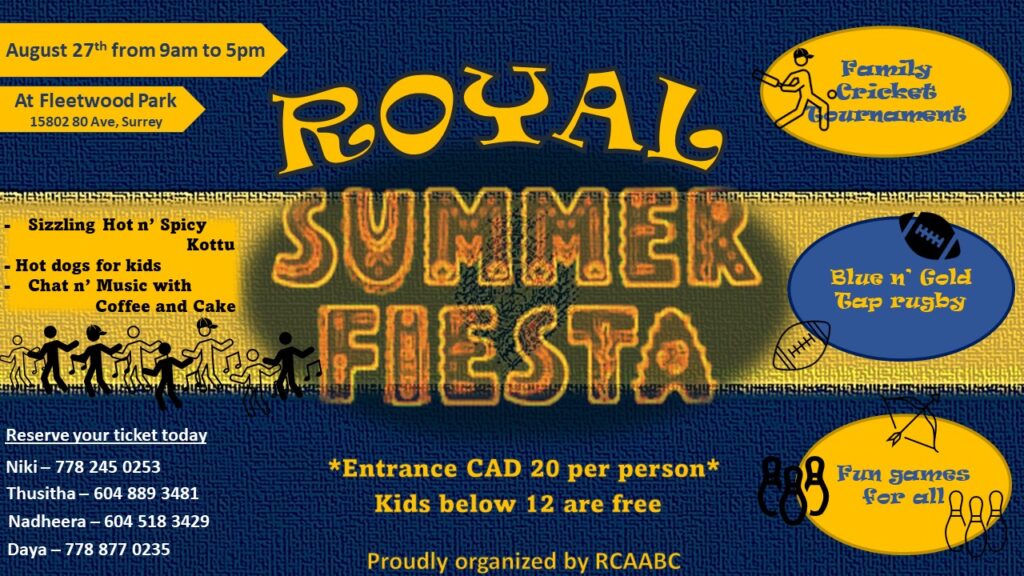
To reserve tickets , Please e-transfer $20 per person to rcaabc.bank@gmail.com
“THANGAIAH PONNIAH” by EARDLEY LIEVERSZ, Captain of Royal College Cricket Team which defeated S.Thomas College, Mt.Lavinia at the Battle of Blues in 1969.
Dr David Ponniah, Warden of St. Thomas’ College remarked in the Thomian souvenir of 2003 that the Royal-Thomian involved people affiliated to the two schools “..coming together to play and witness a game of cricket.” Implied in his remark was that the nostalgia and collective traditions of the spectators provided an indispensable backdrop to what went on in the middle.
However, the greatest character to grace the Royal-Thomian encounters neither studied nor taught at either of the schools, but was a humble gram seller who was affectionately known as Kadalay.
T.M.K. Samat was to sport writing in the 1960s what Neville Cardus was to Anglo-Australian cricket literature. Along with Bertie Wijesinghe, his erstwhile colleague at the Ceylon Observer. Samat covered the Royal-Thomian matches of the period, with great insight and evocative prose. According to Samat, in the mid-1930s Thangiah Ponniah (aka Kadalay) worked as a dressing boy for Jockey Don Benjamin. Thangiah’s duties were to prepare the jockey and saddle the horse before every race. He subsequently worked as a ball picker on the Royal College tennis courts. However, he came from a family of gram sellers resident in Slave Island and this was to be his main profession.
Kadalay arrives at Royal
Although Kadalay claimed to have been a follower of Royal College cricket since 1937, when Pat McCarthy was playing, he came to Royal in 1947 as a 21-year boy to assist the female gram seller Kadalay Achchi. (Although he couldn’t remember the year, he remembers M. Kasipillai as Royal’s cricket captain.) He used to sell vadai next to Kadalay Achchi and also collected debts for her. Subsequently he was allowed to sell gram by himself but only outside the college premises. It was only following the death of the Kadalay Achchi, in the early 1960s, and when his black beard had turned white, that he started selling inside the college premises. At the 10.15 a.m. interval he parked his box in an area triangulated by the hostel, cycling shed and the west wing. This area is now occupied by a large three storied building similar to the east wing of the school. His association with Royal ended in 1991, the year he passed away.
Mixing business with sport
Kadalay’s business was contained in a glassed wooden box, about two feet long and a foot wide, with glass panelled sides. In this was contained a selection of “taste” gram, thambappu (boiled) konde and bola kadalay with slices of newspaper to wrap up the gram and lime to give “taste”. Although gram was his mainstay, he also sold a variety of vadai (masala and isso with a prawn on top) and coconut toffee. In the 1960s all his products sold at 5 cents a piece.
Kadalay would deftly fill the paper cones with gram and neatly stack them on a side during slack periods. His fingers were small and well-shaped, and lacked the roughness of a manual worker.
During cricket matches at Reid Avenue, he was wont to park his business in the vicinity of the jam fruit tree at the point at which the two walls which separated Royal from Thurstan College intersected. On Saturdays, he sometimes arrived at the grounds unencumbered after fortifying himself with spirits. As a result he was more vocal in his comments. Not unlike his loyalty to Royal, Kadalay’s attire was consistent – white shirt and saron. He only shaved his white beard after obtaining white collar employment in the late 1990s which returned him to the clean shaven state that attended his arrival at Royal. In the 1970s he lived in the school’s old cycle shed although where he lived before that is a mystery.
Kadalay symbolised the ecumenical spirit of the times.
He communicated mainly in English and Sinhalese, the only concession to his Dravidian ancestry being the manner in which he addressed everyone as “Dorai”. To all those who knew him, he was simply the best supporter and friend Royal ever had. His identity was trans-ethnic.
An ubiquitous presence at sporting fixtures
Not only did Kadalay not miss a Royal-Thomian match, he hardly ever missed a game of cricket or rugby, even turning up when Royal played in Kandy. Kadalay was known to clear the cigarette butts, empty liquor bottles and other telltale items from the dormitories of St. Anthony’s and Trinity Colleges, prior to the arrival of the master-in-charge in the morning.
At Asgiriya in 1964, it was Kadalay who warned the vice-captain of the cricket team and a future Royal cricket captain, then a fresher of a plan to harm them. And during sparsely attended third term cricket games at Reid Avenue, Kadalay’s presence lent importance to the proceedings.
Whether it be cricket, rugby, athletics or any other sport, attended by all manner of VIPs, it was Kadalay mingling in the outer that completed the picture. He was to major sporting events what the Oval’s ivy covered scoreboard was to the Royal Thomian’s aesthetic setting. Kadalay also made his presence to minor sporting fixtures, Tissa Atapattu recalls being padded up to bat in a Royal “A” fixture against St. Peters at Reid Avenue in 1953. Kadalay who was standing by him commented in Sinhalese that “Today we can boil two eggs in Mr. Atapattu’s stomach” in reference to “butterflies in the stomach” which Tissa had difficultly in suppressing. The laughter all round relaxed the player who subsequently fared well with the bat.
It is very likely that Kadalay attended more sporting encounters involving Royal College than any other Royalist. His association with Royal sport was so complete that it buried all other associations he may have had. Almost nothing is known of his parents and siblings. As a result of his ubiquitous presence he developed a sporting wisdom which qualified him to comment on the state of games. He often picked cricket, rugby and relay teams ahead of the official selection and was very vocal when players who did not meet his approval were picked.
Punithakumar, one of a family of six Royal hookers between 1963 and 1973, recalls that if there was a pivotal scrum in which Royal lost the ball and her opponents capitalised on the mistake and went on to win, he reminded you the next day in no uncertain terms the cost of losing the ball in critical play. His cry “Ennah Dorai” said it all.
By the early 1950s Kadalay was already a Royal institution and icon. His exuberance was exemplified in 1961 at the end of the public schools 4×400 relay. When Darrell Lieversz gained the baton for the final lap Royal were running third. However, he gained ground to win the relay for Royal. Kadalay embodied Royal’s elation by running up to Darrell, hugging him and carrying him off his feet, spikes and all. Kadalay was also a vociferous supporter of the Royal boxing team at Stubbs Shield encounters. He was familiar with every punch in the boxing manual and advised the Royal boxer on the most appropriate punch to use while the fight was on. After the bout, if the Royal boxer had won, he took all the credit for the win. He attributed a loss to the boxer’s failure to follow his instructions and urged him to train harder and not bring shame upon Mr. Damant Obeyesekere, the legendary Royal boxing coach.
Making his mark on the
Royal-Thomian
During his 43 year association with Royal, Kadalay witnessed four Royal wins over STC (1951, 1969, 1983, 1990) and possibly a fifth (1991), and was present at four Royal defeats at the hands of STC (1952, 1953, 1964 and 1988). During this period, the Royal-Thomian was played at the Oval and the SSC grounds. Kadalay’s reaction to Royal’s wins in 1951 and 1990 isn’t known to the writer. In 1983 he is reported to have led the celebrations and to have carried Royal’s cricketers around the ground. However, he was in his element in 1969 and took credit for Royal’s win.
Before the 1969 Royal-Thomian T.M.K. Samat interviewed Kadalay who remarked:, that in order to win, all Royal had to do was to capture the wickets of Jayasekera, Kariyawasam. Wijeysooriya and de Saram quickly. Samat later observed that Kadalay did much to protect his prediction.
The glory of his prediction
Sensing that pitch invasions would lose Royal time and derail Royal’s attempts to capture the remaining Thomian wickets in 1969, he used his authority to restrain Royal’s enthusiastic supporters. Around 5.30 p.m. on the second day, the last Thomian pair were at the crease, Royal were on their way to a victory they had waited for 18 years and Kadalay knew that only something that wasn’t cricket would thwart Royal.
When an appeal was made unsuccessfully against the last Thomian pair, a large contingent of Royalists invaded the field and pitch. Fearing that this would encourage the Thomians, who had nothing to lose, Royal’s captain raced towards the Royal boy’s tent and urged the stewards to control the Royalists and prevent a repeat of such an incident. The captain’s eye caught that of Kadalay whose look captured the seriousness of the situation. That Kadalay could subsequently keep the Royalists behind the barrier at such a pivotal stage in the game speaks volumes for the respect Royalists had for him.
According to an article by Samat which appeared after the game, Kadalay spent the evening following Royal’s win at the beer stall of the Royal Fair basking in the glory of his prediction. Old boys from all walks of life shared a drink with him. Doctors, lawyers, businessmen and other distinguished old boys left their addresses with him in case he needed their assistance. (Such help was needed in the early 1980s when he was put out of school and a case filed against him. Kadalay won the case and it is said that prosecution lawyer, defense lawyer and the judge were all old Royalists.)
There was no finer testimony to the iconic status of Kadalay than that Royalists, young and old, treated Royal’s first win over STC in 18 years as his personal triumph. After all no one had cheered, encouraged and championed Royal’s cricketers for as long as Kadalay, and if anyone deserved to savour this particular moment, it was him.
While Kadalay was being interviewed a car stopped and the occupant put his hand out to offer his congratulations. The moment the car left, Kadalay remarked to Samat that he didn’t need help from anyone. All he wanted was that kind of acceptance and to be identified as part of Royal. This then is what made Kadalay such a special figure. Although he never studied or taught at Royal, and emerged from a humble background, through his devotion to the cause of Royal sport, he became so well-known, that he embodied the school’s greatest sporting moments more than the players involved.
Kadalay worked out his priorities. To have accepted an offer of white collar employment would have separated him from his beloved Royal and his interactions with Royalists. Hence, as long as he had enough to get by he was happier being close to his school.
Royal benefited from Kadalay’s decision for there was no one better placed to pass on traditions, anecdotes and folklore from one generation to another. No one had more credibility than Kadalay who himself had long since passed into Royal folklore. Many an old boy with a distinguished sporting record relied on Kadalay to convey his past glories to the present generation.
Tissa Atapattu states that Kadalay boosted his ego and that of all Royal sportsmen who visited the school. He referred to Tissa as “Appay Mahaththaya, Mr. Atapattu” and made him and others like him feel like they were the best Royal had produced. Kadalay could recall in detail every tackle Tissa made or missed, when he dropped the ball or made a good run as wing three quarter, and his triumphs and failures in pole vault. I am certain that many other old boys had similar experiences.
Most significantly, Kadalay treated Royalists equally regardless of whether they were stars or only played house sport. He would make a person who never made the first XI special by recalling some obscure performance in a house cricket match.
He defined the times
As was the case with many of our masters, we came to appreciate Kadalay after we left school, and after his death. In retrospect, we realise how much he defined the times and made them unique. All prestigious schools produced great sportsmen and scholars, and had excellent teachers. But Royal also had Kadalay. How many schools could boast a character like him? It was Kadalay, not so much Royal’s sporting and academic achievements, important as they are, which made Royal and Royalists special.
Playing the game
Niranjan Selvadurai remarked that Kadalay may not have read of books and men but he always played the game. More precisely, he read the game better than most. Hence, his views on games and sportsmen are particularly valuable.
Kadalay’s views on Royal’s finest were recorded in the 1974 Royal cricket souvenir. Although he is likely to have altered his views in the next 17 years, they are still worth mentioning for what they reveal about him.
Kadalay’s best bowler, fielder, all-rounder and wicket-keeper were Asita Jayaweera, Lorenz Pereira, Nanda Senanayake and S.D. Jayaratne respectively. Although he is recorded in the souvenir as stating that Vijay Malalasekera was Royal’s best batsman, he is also reported to have said the best batsman Royal produced never played in either the Royal-Thomian or for the First Eleven. His name was Sarath Kodagoda.
His favourite captain was Jagath Fernando whom he said played for the sake of the game. In 26 years of cricket (1947-1973) his most memorable Royal-Thomian was that of 1969 for the team spirit Royal demonstrated.
According to Royal’s rugby fraternity Kadalay’s favourite ruggerites were Lionel Almeida, Maurice Anghie, Lorenz Pereira and Jagath Fernando. He vividly recalled Maurice and Lorenz weaving and side stepping at Nittawella in 1958 before touching down. Other highlights for him were Lakdasa Dissanayake’s drop goals which nailed Trinity in 1964. And he was positively thrilled when Royal whacked Trinity in 1968 – whether it be at Longdon Place, Havelock Park, Nittawela, Asgiriya, Bogambara or Peradeniya,
Kadalay was wont to follow Royal’s linesman during junior and senior games admonishing the boys in blue and gold to “jump for the ball and run, run, run”, and being ecstatic when points were scored. Kadalay used to say that Rahula Silva was the most deadly boxer Royal ever produced. He also had a high regard for the Henricus and Anghie brothers, and Padde Withana who prematurely gave up hitting with leather for hitting at leather and played in the famous 1962 cricket XI.
A man of principle
In addition to his knowledge of sport and memories of great moments in Royal sport, Kadalay stood out because of his dignified bearing. Even when under the influence he behaved with complete decorum and never went overboard. He was an example to many a schoolboy who was inclined to show off by acting the fool and exceeding the boundaries of harmless mischief.
Never did he think of hurting other people in business. Jayantha Wickremasuriya observes that although there were enough opportunities for him to compete with Balloon Man (aka Bella) before Francis came into the scene, Kadalay never expanded his “business territory”. Kadalay was content to stick to his niche market. Kadalay never fought with others although Bella and Francis had several altercations. And Bella’s son, with the help of some old boys, looked after Kadalay in his final days.
A self-made Royalist.
While most Royalists merely passed through, Kadalay’s links with Royal were more enduring. Apart from the small minority of old boys who devote their lives to either coaching at the school or participating in organising committees, many of us lose interest in the school after leaving it. Our enthusiasm is greatest when in junior school or When hogging the limelight.
To Kadalay, however, Royal was his whole life. Because his association with the school was voluntary and wasn’t derived from membership of the student or school body, or any family links. Kadalay’s devotion to Royal was bereft of self-aggrandisement or ego.
Kadalay had to carve his own path to glory without the inbuilt advantages alumni had. In this manner he became a genuinely self-made Royalist although an honorary one.
A generous spirit
Although poorer than his clientèle there was many an occasion when Kadalay lent students bus fare. The mother of one particular student whose son once lost his bus fare and was rescued by Kadalay was always grateful to him. When Kadalay’s obituaries appeared in the local papers she cut them out and sent them to her son who was domiciled in Singapore.
The end of a 43 year association
In the late 1980s, when in his late fifties. Kadalay obtained employment at a business run by ex-Royalist entrepreneurs and housed at Vauxhall Street. He used to reside on the premises of Royal College. A former prefect and house captain used to collect him after dropping his son off at school and take him to work. He did not have any specific job to perform and he used to sit at a desk at the entrance to the office more like a guest relations officer. When he passed away in 1991 he was back at Slave Island where it was believed he was born.
Kadalay was last seen on 9 March 1991 at SSC grounds on the occasion of the old-boys match. People had noticed how weak he looked. He passed away a week later, on 17 March, the day after Royal beat STC by 9 wickets. It appears that he was too ill to attend the Royal-Thomian. It is not known whether he followed the game or not, and if he did, what his emotions were on hearing the news. One thing’s for sure. With good health the years 1990 and 1991 would have been the highlight of his life. Two successive Royal wins in the Royal-Thomian would have exceeded the wildest fantasies of a person who devoted his life to Royal cricket and sport.
Thangiah Ponniah gave his all for Royal and contributed much to her sporting camaraderie. In return Royalists either looked after him or cherished his example. We are all the richer for having represented Royal on the playing field with him in the audience or simply having had exchanges with him on matters of sport. We will never see the likes of him again. Kadalay’s legacy is not reflected in school records or honour rolls. It is etched in the hearts of everyone who knew him. Kadalay rest in peace wherever you are.
Note: The author acknowledges the contributions of Niranjan Selvadurai. Edward Silva, Pryan Fernando, Nirmal Hettiaratchy: Punithakumar. Mithila Gunaratne. Darrell Lieversz. Brian Lieversz, Kusum Perera, Jayantha Wickremasuriya. Tisara Gunasekera, Tlssa Atapattu, Prasanna Mendis, Randolph Baptist and T.M.K. Samar. Edward Silva filled me on Kadalay’s involvement in Royal’s boxing events. He also provided the background material required to kick start the article. Niranjan Selvadurai and Pryan Fernando provided many profound insights into the character of Kadalay. Mithila Gunaratne made useful editorial suggestions. Tisaray Ganasekera sent me copies of obituaries on Kadalay. Darrell Lieversz, Tissa Atapattu and Punithakumar provided me with anecdotes of their dealings with Kadalay.
Kusum Perera took me deep into the botanical subject of Kadalay’s business and acted as a sounding board for my ideas. I am also grateful to Jayantha Wickremasuriya for correcting me on Kadalay’s product range and educating me on sidelights of Kadalay’s business. Finally, the interviews Samat had with Kadalay, before and after the 1969 Royal-Thomian and which appeared in the local press, contained invaluable information on Kadalay’s past and how he wished to be seen. Kadalay unites old-Royalists from far flung regions which is testimony to the irrevocable grip he continues to have on our psyches and the manner in which he is intertwined with our memories of school days.
(NOTE: Article in The Island paper is published courtesy of the author).
What goes into a blog post? Helpful, industry-specific content that: 1) gives readers a useful takeaway, and 2) shows you’re an industry expert.
Use your company’s blog posts to opine on current industry topics, humanize your company, and show how your products and services can help people.